

Expert:Dr. Xiaoyan Liang
Role: Lead Education Specialist,and the Global Co-Lead for Technical and Vocational Education and Training (TVET) and Skills at the World Bank Group’s Education Global Practice.
Impact:Dr. Liang holds a Bachelor of Science degree from Shanghai Jiao Tong University, and Master’s and Doctor of Education degrees from Harvard University. With nearly three decades of experience in international development, her expertise spans early childhood education, teacher development, STEM education, TVET and skills development, higher education, and science and technology, as well as cross-cutting areas such as education finance, governance, poverty reduction, and inclusion. She has led and managed numerous education research and investment projects across nearly twenty countries in Africa, East Asia, South Asia, Latin America, and the Middle East. A strong proponent of South-South cooperation, shehas facilitated numerous joint education programs between African countries and partners including China, India, Korea, and Singapore. She focuses on sustainable education development and has published extensively, including the widely cited How Shanghai Does It and other works on education and skills development.
Editor's Note:
Education development as a national priority has been a core strategy underpinning China's economic and social progress. Over the past four decades, China has put in place a series of policies to build a high-quality modern education system, integrating development of education, science and technology, and human capital. These efforts have propelled the country's historic transformation. China's education policymaking is deeply rooted in its social context, while also resonating with global trends in educational reforms. Dr. Xiaoyan Liang has long been engaged in international education development and cooperation. Through her practice, she has identified key policy lessons from China's Education and Training System, presenting to the world, especially countries in the Global South, a pragmatic and effective path toward educational modernization.
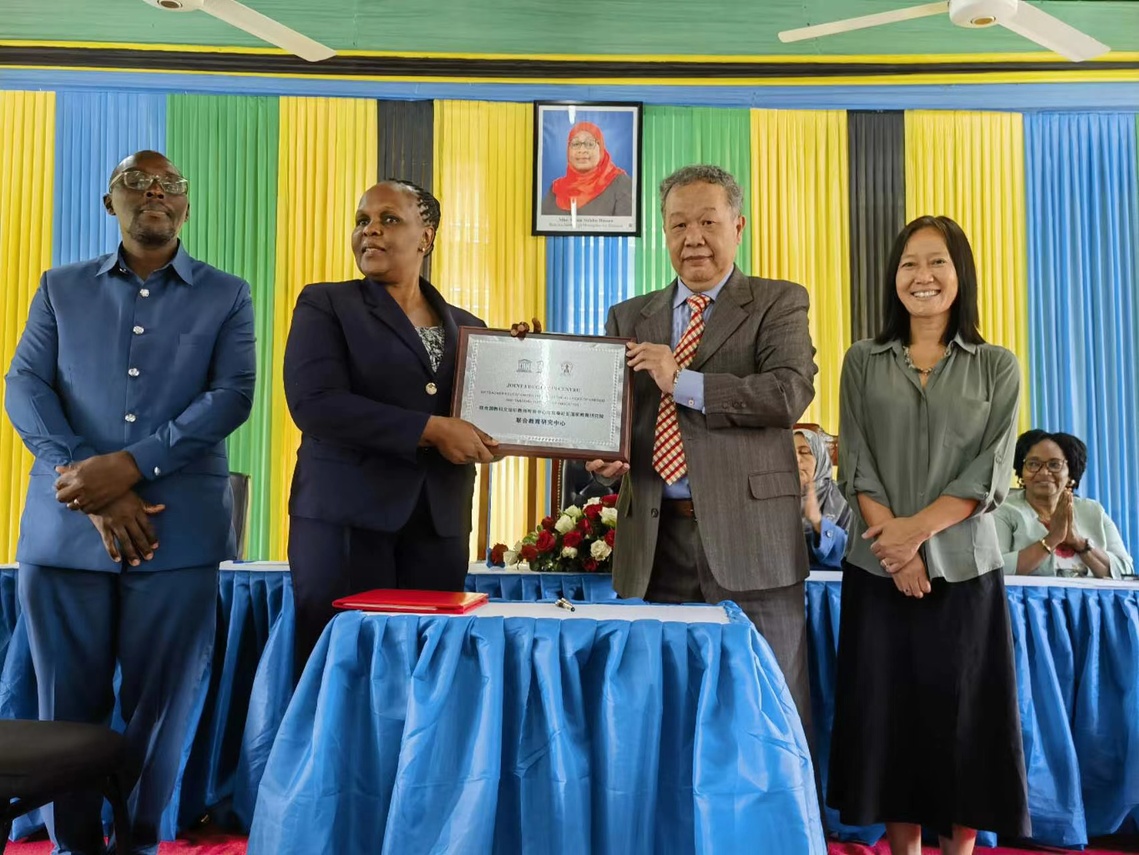
Photo| Dr. Liang witnessed the MOU signing ceremony between UNESCO-TEC and the Tanzania Institute of Education
China's economic transformation over the past four decades is widely studied; far less attention has been paid to the education and training system that underpinned it. Yet education reform has been integral to China's development trajectory, supplying the human capital needed for structural transformation, productivity growth, and social mobility.
Over four decades, China universalized nine-year compulsory education, eradicated adult illiteracy, raised senior secondary enrollment from 29 percent in the 1980s to near universal coverage, and expanded higher education participation from 4 percent to over 50 percent. These achievements reflect not only rapid expansion, but also sustained improvements in quality, relevance, institutional capacity, and labor-market alignment.
While China's scale and political context are unique, its experience offers valuable lessons for countries seeking to expand access while improving quality, relevance, and equity in education and skills development.
Strong State Stewardship with Decentralized Accountability
A defining feature of China's education system is strong government stewardship combined with decentralized implementation. National authorities set priorities, outcome targets, learning standards, and minimum quality thresholds, while provinces, districts, and schools retain autonomy to adapt delivery to local conditions.
China operates a national curriculum framework with clear learning standards, affordable curriculum-aligned textbooks, national and provincial cloud-based e-learning banks. Advanced jurisdictions may develop localized curricula and materials, provided national requirements are met. Decentralization is paired with accountability through compliance evaluations, performance monitoring, and targeted fiscal transfers that enable poorer regions to meet national benchmarks. Local governments and institutions are granted flexibility in how they organize teaching and learning, but are held accountable for meeting minimum standards and improving results.
This combination of autonomy with results-oriented oversight has allowed China to maintain system coherence and equity while encouraging local innovation and responsiveness.
Teachers as the Foundation of System Performance
China's sustained focus on teachers is central to its education outcomes. Teaching is treated as a professional career, supported by selective recruitment, rigorous pre-service preparation, structured career ladders, and continuous professional development embedded in everyday practice.
A distinctive and highly effective feature of the system is the Teaching Research Group (TRG), which serves as the backbone of teacher continuous professional development. TRGs are school-based, subject-specific professional communities in which teachers collaboratively plan lessons, observe classroom practice, analyze student learning, and refine instructional approaches. Rather than relying on episodic workshops, TRGs are institutionalized as part of teachers' regular workload and closely aligned with curriculum and assessment requirements.
TRGs function simultaneously as peer-learning communities, instructional laboratories, and accountability mechanisms. They are supported by local education authorities, linked vertically across schools and districts, and increasingly strengthened through digital platforms that allow master teachers to mentor wide networks of practitioners. This model has proven effective in diffusing instructional excellence, supporting novice teachers, and ensuring consistent implementation of curricular reforms at scale.
Pre-service preparation further reinforces professionalism through specialized teacher education institutions that integrate subject mastery, pedagogy, ethics, and practical teaching experience. Teacher development is embedded in promotion pathways and backed by dedicated financing, while policies requiring salaries comparable to civil servants reinforce the attractiveness and status of the profession.
Modern TVET: A System Built Around Industry–Education Integration, Pathways, and Results-Based Financing
China's"modern TVET" agenda frames vocational education as a distinct education type rather than a residual track, with rising expectations for quality, relevance, and social status. National reform plans articulate a long-term vision of a modern vocational education system that enjoys parity with general education while serving as a key pillar of economic upgrading.
A defining feature is the institutionalization of industry–education integration as a system-level governance mechanism. Employer engagement extends well beyond internships. Enterprises participate in identifying competency requirements, shaping occupational standards, and co-designing curricula. Education authorities safeguard broader learning objectives through education standards and quality requirements, while institutions translate these dual mandates into programs that combine campus-based practical training with structured work-based learning. In many regions, place-based platforms—such as industry–education integration zones or skills parks—anchor vocational provision to local industrial strategies.
Modern TVET also emphasizes permeability and multiple pathways. Clear progression routes exist from secondary to tertiary vocational education, alongside expanding bridges between vocational and academic tracks. These arrangements reduce dead ends, mitigate stigma, and support lifelong learning, while academic programs increasingly adopt applied orientations.
Financing plays a central role in driving reform. Rather than relying solely on formula-based allocations, national and provincial governments deploy results-based financing and competitive grants to incentivize change. TVET institutions compete for targeted funding linked to priorities such as industry partnership, curriculum modernization, faculty upgrading, and graduate employment outcomes. Selected institutions receive time-bound investments to develop into model or demonstration colleges equipped with modern facilities and strong industry linkages. Performance monitoring and periodic evaluations ensure that additional autonomy and resources translate into measurable improvements rather than entitlement.
Modern TVET reforms are further supported by a strengthened standards and credentials architecture. In recent years, the government has updated more than 700 national TVET standards to align with emerging technologies and national strategic industries, including renewable energy, advanced manufacturing, digital technologies, and modern services. Updated standards guide curriculum design, teaching requirements, assessment, and certification, helping ensure that vocational qualifications remain relevant, portable, and trusted across regions and employers.
Pragmatic Sequencing and the Use of Model Institutions
China's reform strategy emphasizes pragmatic sequencing, prioritization, and demonstration effects, closely paralleling the logic of its economic reforms through Special Economic Zones (SEZs). Rather than pursuing uniform, system-wide change from the outset—particularly in more complex and differentiated subsectors such as TVET and higher education—the government concentrates resources, policy flexibility, and accountability mechanisms in competitively selected model institutions.
Through performance-based and competitive grants, these institutions are equipped with modern facilities, upgraded faculty, and strong industry linkages, and are granted greater autonomy to experiment with new governance arrangements, curricula, and partnership models. Successful practices are then codified and scaled across the broader system, while less effective approaches are adjusted or discontinued. For example, national and provincial governments have supported waves of model vocational colleges and applied universities, which pioneered industry-integrated curricula, dual-qualified faculty models, and work-based learning arrangements before these approaches were diffused system-wide through policy guidance and standards.
Much like SEZs functioned as laboratories for market-oriented reforms prior to national rollout, model TVET institutions and higher education programs have served as policy testbeds for pragmatic reform at scale—allowing governments to reduce implementation risk, build institutional capacity, and demonstrate results before wider adoption.
ICT and AI as System-Level Accelerators
China's investments in digital infrastructure have enabled technology to function as a system equalizer, extending quality instruction and teacher expertise to underserved regions. The country has near universal coverage of 4G or 5G internet. National digital platforms host curriculum-aligned resources, while livestreaming and satellite technologies allow high-performing teachers to reach large numbers of students, with local teachers facilitating follow-up learning.
More recently, artificial intelligence has begun to reshape teaching and learning. Selected provinces have piloted AI education in primary schools, introducing age-appropriate concepts such as data awareness, computational thinking, and basic AI applications. AI tools are also being used to support adaptive learning, instructional design, and teacher feedback, guided by national frameworks emphasizing ethical use and pedagogical purpose.

Photo| Dr. Liang attended the Shanghai Learning Events for African Educatorshosted by UNESCO-TEC
Conclusion
China's education and training experience shows that rapid expansion, quality improvement, and equity can advance together through pragmatic reform at scale. Strong state stewardship paired with decentralized accountability, institutionalized teacher professional development through Teaching Research Groups, a modern TVET system anchored in deep industry–education integration and results-based financing, and the strategic use of digital and AI technologies have collectively enabled sustained system-wide improvement. While institutional contexts differ, these elements illustrate how disciplined sequencing, selective prioritization, and results-oriented implementation can translate ambitious policy goals into durable outcomes in large and complex education systems.
Editor: REN Zhen